Reimagining the Institution as a Faithful Neighbor
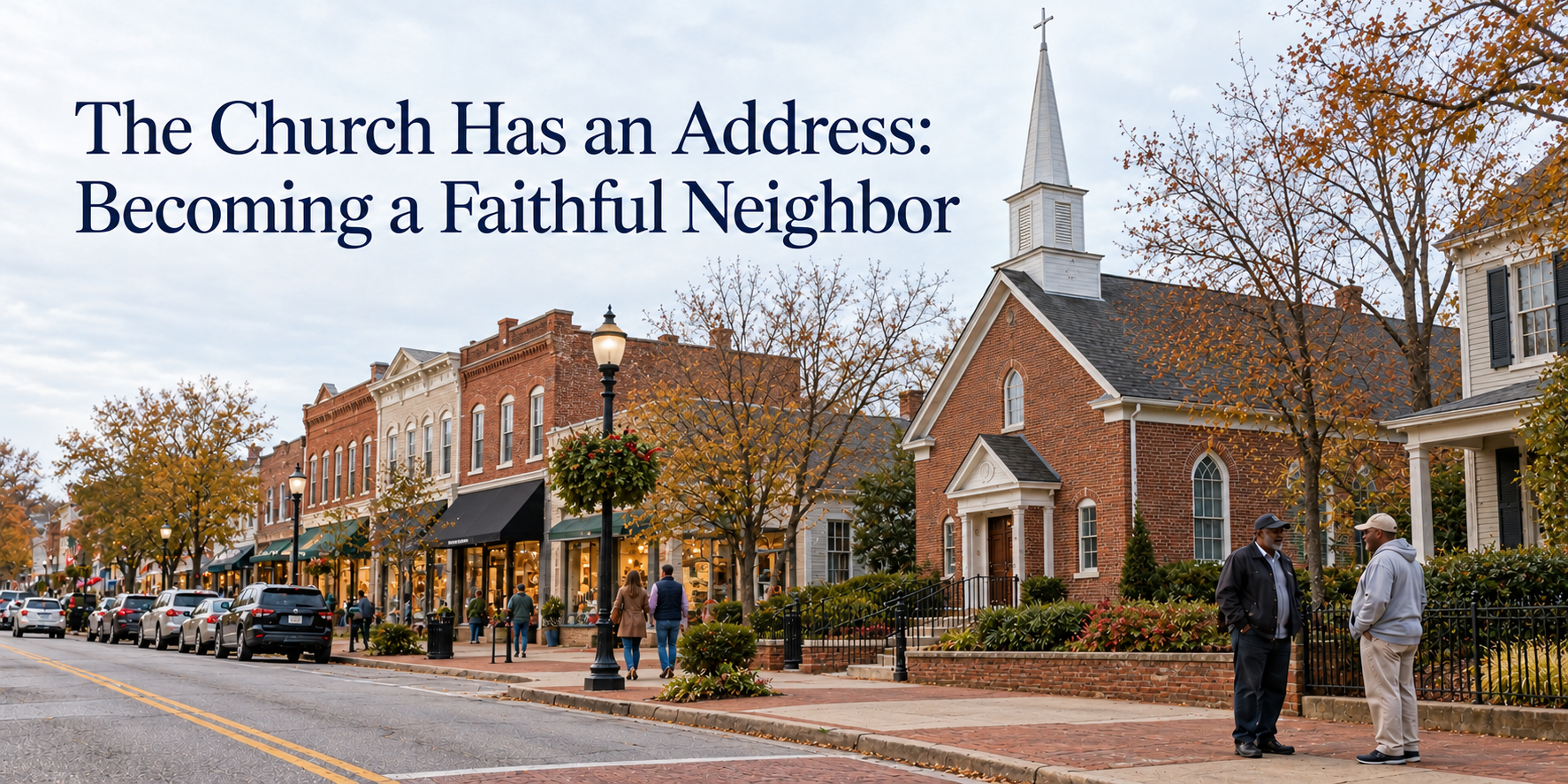
Every church has an address. Not every church knows its neighborhood.
For three days in Charlotte, pastors and congregational leaders gathered at SouthPark Church to consider property, stewardship, vision, and change. SouthPark’s pastor and leaders told the story of a congregation that reconsidered the relationship between its property and its mission. Their journey included difficult decisions, financial realities, resistance, grief, partnerships, and possibilities they could not fully see when they began.
We were not there to copy SouthPark. Its decisions belonged to its history, location, resources, and calling. Its story gave us something more useful than a blueprint. It helped us ask better questions about our own addresses.
The choice before churches is not institution or community. Congregations need durable practices, trustworthy leadership, shared memory, financial structures, and places where a common life can take shape. The needed movement is a reimagining of what those structures are for.
Do they exist primarily to preserve the congregation as it has been, or do they help the church become a faithful presence among the people who live nearby?
A Building Carries Memory
A conversation about a building is almost never just a conversation about a building. Sanctuaries and hallways hold baptisms, weddings, funerals, children’s voices, Wednesday suppers, and the memory of people who taught us to pray. A room that appears underused on a floor plan may be full of meaning to those who remember what happened there.
When someone says, “This building is our church,” the statement may be theologically imprecise, but it is emotionally honest. The building has become bound to identity and belonging. Leaders who dismiss that attachment as resistance will misunderstand what they are hearing.
Resistance is often information. It may tell us what people fear losing.
Faithful leadership honors what a place has meant without allowing the past to determine everything the church can become. Even faithful change carries loss. People may support an emerging vision and still grieve what is passing away. Grief does not necessarily mean the congregation has rejected the future. Sometimes grief is part of the journey toward it.
The Institution Serves the Calling
We often repeat that the church is not the building. The sentence is true, though it can become a way of avoiding serious reflection about the building. Property is one of the gifts entrusted to a congregation for a season. It can serve the church’s calling, or it can slowly become the calling.
Maintenance questions remain necessary. Roofs leak, budgets tighten, and air conditioners seem to possess a spiritual gift for failing during the hottest week of July. Yet maintenance cannot carry the whole weight of stewardship. A congregation must also ask whether its property supports the ministry it now understands itself to have.
The more searching question is not simply, “Can we afford to keep this building?” It is, “How might what has been entrusted to us participate in what God is already doing in this place?”
One church may renovate, another may share space, another may develop partnerships, and another may sell. Selling is not necessarily failure, and keeping a building is not necessarily faithfulness. The response must grow from mission, context, capacity, and discernment.
A Church Belongs Somewhere
Many congregations became regional destinations. Members drove past several churches to attend the congregation that matched their theology, denominational identity, worship preferences, or family history. That pattern has not disappeared, but denominational loyalties and attendance habits have changed.
At the same time, some congregations are recovering an older Christian understanding of place.
The incarnation gives this conviction its theological center. The Word became flesh and dwelt among us. God’s love took up residence. Jeremiah told the exiles to seek the welfare of the city where they had been sent.
Christian faith is embodied and located. We love actual people in an actual place.
Hyper-local ministry begins with attention. Who lives nearby? What has changed in the neighborhood? Which organizations are already trusted? What wisdom do our neighbors possess that the congregation needs to hear?
This work cannot be reduced to opening the church doors and inviting people inside. Churches can remain institutionally centered while offering generous programs. The deeper movement is from doing ministry for a neighborhood to becoming a partner with the neighborhood. Neighbors help name the questions and imagine the responses. The church learns to receive as well as give.
A regional congregation need not abandon the people who travel to be part of it. The choice is not regional or local. A gathered congregation can still take responsibility for the place where it gathers.
The issue is whether the church knows its address as more than a mailing location.
Property Discernment Is Congregational Discernment
Property may be the presenting issue, but underneath it are questions of identity, trust, memory, power, and vocation. Who are we now? Why are we here? What are we willing to release? Whose voices matter? What future are we prepared to enter?
An engineer can tell a congregation whether a wall can be moved. A financial advisor can estimate the cost. A developer can describe what the land may be worth. Those forms of expertise matter. None can tell a congregation who God is calling it to become.
That discernment requires meaningful participation. Leaders may spend months studying possibilities and slowly arriving at a decision. When they finally present it, the conclusion feels obvious to them. To the congregation, it can feel sudden. What leaders experienced as discernment, the congregation may experience as announcement. Trust grows when people enter the questions early enough for their participation to matter.
The work of leadership is to guide a process through which the congregation faces reality, recovers its purpose, listens to its neighbors, and discerns a faithful way forward. The answer will differ from one address to another because faithfulness is always lived somewhere.
Taking Our Address Seriously
SouthPark gave us no blueprint to carry home. It gave us a story that helped us see our own congregations more honestly. Its witness was not, “Do what we did.” It was, “Take your own address seriously.”
Perhaps faithful stewardship begins there. Before deciding what to renovate, preserve, share, develop, sell, or build, a congregation looks again at the place where God has planted it. It listens to its neighbors. It remembers why it exists. It asks what its resources might make possible.
The building is not the church. The neighborhood is not the church either. The church is a people called by Christ and sent to love the place where they live. Its institutional life and property matter when they help those people in their community become a faithful presence there.
Every church has an address. May our neighbors know that we live there.

Leave a Reply